Introduction
Before NCAA v. Alston,1141 S. Ct. 2141 (2021). the NCAA thought it should be exempt from paying student-athletes fair wages because of the vague concept of amateurism.2NCAA v. Alston, 141 S. Ct. 2141, 2152 (2021) (noting that in the district court proceedings, the NCAA had not defined “the nature of the amateurism that they claim consumers insist upon” and that, at best, it served as a differentiator from professional sports). In theory, it would be free to argue that “because of the special characteristics of [its] particular industry,”3Id. at 2160 (Kavanaugh, J., concurring) (alteration in original) (internal quotation marks omitted) (quoting Nat’l Soc’y of Pro. Eng’rs v. United States, 435 U.S. 679, 689 (1978)).—namely, its employment of amateurs—“it should be exempt from the usual operation of the antitrust laws,”4Id. but that argument falls flat under current law. Indeed, the NCAA’s reliance on amateurism as a justification for its anticompetitive behavior is losing favor. As Justice Brett Kavanaugh observed in NCAA v. Alston,5“For years, the association’s ‘amateur’ model of intercollegiate athletics has been under attack, with critics highlighting the system’s perceived exploitation of its student-athletes.” Nathaniel Grow, The Future of College Sports After Alston: Reforming the NCAA Via Conditional Antitrust Immunity, 64 Wm. & Mary L. Rev. 385, 388 (2022). “[t]he NCAA’s business model would be flatly illegal in almost every other industry in America.”6Alston, 141 S. Ct. at 2167 (Kavanaugh, J., concurring); see also Maryclaire Dale, US Appeals Court to Weigh NCAA Case Over Pay for Athletes, AP News (Jan. 17, 2023, 8:30 PM), https://perma.cc/3UL2-YE32.
The NCAA is the major governing body for college athletics, presiding over membership from over 1,200 colleges and universities.7Justin Berkman, What Are NCAA Divisions? Division 1 vs 2 vs 3, PrepScholar: Advice Blog, https://perma.cc/DK2P-RZ7Y. Within the NCAA, there are three divisions, with Division I schools having the highest athletic department budget and most competition, and Division III schools having the least.8Id. Currently, 204,000 student-athletes participate in a Division I program, 133,000 in Division II, and 202,000 in Division III.9NCAA, NCAA Recruiting Facts, https://perma.cc/47F6-AHT8. Athletic scholarships are offered in Division I and II, but not Division III.10Id.
Because Division I schools are the largest economic institutions of the three with their budgets and scholarship offerings, this Comment focuses mainly on Division I athletics. There are fifty-one active Division I athletic conferences governing 355 colleges and universities.11NCAA, NCAA Directory: Conference Members, https://perma.cc/PZ5L-VMG6; NCAA Recruiting Facts, supra note 9, at 1. Within the college athletics market, top conferences have market power in the recruitment of student-athletes for their athletic programs.12See Roger D. Blair & David L. Kaserman, Antitrust Economics 108 (2d ed. 2009) (“[A]ll else equal, we find that a positive relationship exists between market share and market power.”); Emily Caron & Michael McCann, Big Ten, ACC, PAC-12 Align as Alston Antitrust Warning Looms, Sportico (Aug. 24, 2021, 4:48 PM), https://perma.cc/BW8M-MCHT (noting that the top five conferences plus Notre Dame, which has no conference, had the highest viewership from 2015 to 2019 and the highest revenue in the 2019 school year). The top five conferences historically are the Big Ten, SEC, PAC 12, ACC, and Big 12.13Signing Day Sports, What Is the Power 5?, The Wire (June 9, 2023), https://perma.cc/UYE8-WYK3. The Pac-12 has all but dissolved as television money enticed members to other conferences during the summer of 2023. Ralph D. Russo, Column: It’s Not Conference Realignment. It’s Consolidation and No One Is Safe in the Dash for Cash, AP News (Aug. 7, 2023, 12:35 PM), https://perma.cc/4HM3-7WHK.
Through an antitrust labor lens, the NCAA itself may be viewed as a monopsony.14NCAA v. Alston, 141 S. Ct. 2141, 2151–52 (2021). Section 2 of the Sherman Act criminalizes “[e]very person who shall monopolize, or attempt to monopolize, or combine or conspire with any other person or persons, to monopolize any part of the trade or commerce among the several States, or with foreign nations.” 15 U.S.C. § 2. A monopsony features concentrated market power in buying labor and generally generates wages that are below market value.15Eric A. Posner, The Rise of the Labor-Antitrust Movement, Competition Pol’y Int’l 2 (Nov. 29, 2021), https://perma.cc/KB36-ULF8. Justice Kavanaugh’s concurrence in Alston argued that “the NCAA’s remaining compensation rules also raise serious questions under the antitrust laws,” and the NCAA admits it underpays student-athletes.16Alston, 141 S. Ct. at 2166–67 (Kavanaugh, J., concurring).
Alternatively, the NCAA may be viewed as a cartel collectively exhibiting monopsonistic power, which is “just a formal (overt) price-fixing agreement.”17See Blair & Kaserman, supra note 12, at 173. Justice Neil Gorsuch’s majority opinion in Alston stressed that individual conferences remain free to impose whatever rules they choose.18Alston, 141 S. Ct. at 2165 (“[I]f the NCAA believes certain criteria are needed to ensure that academic awards are legitimately related to education, it is presently free to propose such rules—and individual conferences may adopt even stricter ones.”). “Individual” stresses that schools within each conference may enter into a joint agreement to underpay student-athletes, which would violate the Sherman Act.19See id. at 2154; Caron & McCann, supra note 12. Regardless of a monopsony or cartel view, the result is suppressed wages for student-athletes.20See Roger D. Blair & Jeffrey L. Harrison, Antitrust Policy and Monopsony, 76 Cornell L. Rev. 297, 297–99 (1991).
For its part, the NCAA holds fast to arguments rooted in the value of amateurism.21Dan Wolken, NCAA’s Arguments in Favor of Amateurism Grow More and More Ridiculous, USA Today (Feb. 20, 2023, 3:32 PM), https://perma.cc/9JPK-YR5N. Recently, student-athletes have tried to make fair pay arguments under legislation like the Fair Labor Standards Act (“FLSA”).22Richard Johnson, Explaining Johnson v. NCAA and What’s at Stake in Wednesday’s Court Hearing, Sports Illustrated (Feb. 15, 2023), https://perma.cc/R3V2-HL4E. But this is not necessary to obtain fair pay—Justice Kavanaugh’s Alston concurrence makes it clear that antitrust labor may be an open door:
Nowhere else in America can businesses get away with agreeing not to pay their workers a fair market rate on the theory that their product is defined by not paying their workers a fair market rate. And under ordinary principles of antitrust law, it is not evident why college sports should be any different.23Alston, 141 S. Ct. at 2169 (Kavanaugh, J., concurring).
Following the Alston ruling, there is no mistake that the NCAA represents buyer-side monopoly power, known as monopsony power, of college athlete labor.24See id. at 2151–52 (majority opinion) (“In applying the rule of reason, the district court began by observing that the NCAA enjoys ‘near complete dominance of, and exercise[s] monopsony power in, the relevant market’—which it defined as the market for ‘athletic services in men’s and women’s Division I basketball and FBS football, wherein each class member participates in his or her sport-specific market.’ The ‘most talented athletes are concentrated’ in the ‘markets for Division I basketball and FBS football.’ There are no ‘viable substitutes,’ as the ‘NCAA’s Division I essentially is the relevant market for elite college football and basketball.’ In short, the NCAA and its member schools have the ‘power to restrain student-athlete compensation in any way and at any time they wish, without any meaningful risk of diminishing their market dominance.’” (alteration in original) (citations omitted)). This power is addressed by the Sherman Antitrust Act.
Article 1 of the Sherman Act states: “Every contract, combination in the form of trust or otherwise, or conspiracy, in restraint of trade or commerce among the several States, or with foreign nations, is declared to be illegal.”2515 U.S.C. § 1. Sherman Act Section 2 addresses monopoly and monopsony power directly, but Alston did not address it. See 15 U.S.C. § 2; Alston, 141 S. Ct. at 2151. Once a court determines that a “contract, combination in the form of trust or otherwise, or conspiracy” exists, one of three standards of legality applies.26Daniel Francis & Christopher Jon Sprigman, Antitrust: Principles, Cases, and Materials 7 (2023). Agreements that are nakedly anticompetitive are per se illegal; agreements that are obviously harmful but have some justification receive “quick look” review; and all others are analyzed under “rule of reason” analysis.27Id. at 7–8 (internal quotation marks omitted). Alston looked at the NCAA’s practices through rule of reason analysis, a burden-shifting framework that ultimately balances anticompetitive harms and procompetitive justifications.28See Alston, 141 S. Ct. at 2151.
Other industries should take note of the Supreme Court’s growing embrace of this framework of remedying monopsony power. This Comment explains the economics and law behind monopsony and seeks to apply the relevant concepts to other industries where wages are also suppressed.
This Comment argues that workers in other industries employed by firms with monopsonistic power should use Alston’s reasoning to advance their arguments about antitrust labor violations in their industries. Section I discusses the economics and history of the labor and antitrust movement. Section II examines the NCAA’s amateurism policies, antitrust rulings before Alston, and Alston itself. After discussing Alston, Section II applies the economic principles outlined in Section I to the NCAA. Section III argues that antitrust laws should be used in lawsuits challenging suppressed wages for workers not formally defined as employees. This strategy, Section III further argues, would be more effective than other strategies currently employed in such litigation. Section IV argues that elements of NCAA labor antitrust concerns are present in other antitrust labor markets such as nurses in hospital systems with monopsonistic power; courts should accept antitrust labor jurisprudence in these areas to protect workers and circumvent employee status.
I. Time Is Money: The History of Monopsony in Labor and Antitrust Economics and Examples of Use in Caselaw
A. Where Did the Idea of Labor and Antitrust Come From?
Courts have seen a boom in antitrust-labor cases in the past decades, leading some to question where the application of antitrust principles to labor markets originated.29See Posner, supra note 15, at 3. While traditional antitrust monopolies center around upward pricing pressure due to selling power, monopsonies are about downward pricing pressure due to purchasing power. For labor, downward pressure on prices means lower wages. Though observers may view the labor and antitrust movement as an innovation,30See id. at 2 (“It is the biggest innovation in antitrust in decades.”). the ideas behind the movement have roots that are as old as antitrust itself. For example, Adam Smith observed in The Wealth of Nations that “masters” (employers, firms, buyers of labor, etc.) have an incentive to cartelize markets, tending toward monopsony, as sellers have an incentive to maximize profit by monopolizing.31Id. Following Smith’s line of thinking, employers or groups of employers with sufficient market power may suppress the wages of workers, paying wages below a competitive rate.32Id. at 2–3.
The concept of antitrust-labor law is rooted in the Sherman Act, the first federal antitrust law enacted in the United States in 1890.3315 U.S.C. § 1. Along with the Clayton Act of 1914, the Sherman Act forms the backbone of Antitrust law in the US. Francis & Sprigman, supra note 26, at 1. States had previously enacted antitrust statutes that affected only intrastate commerce. For example, Kansas passed its statute in 1889. Yang Chen, Sherman’s Predecessors: Pioneers in State Antitrust Legislation, 18 J. Reprints Antitrust L. & Econ. 93, 94 (1988). Section I outlaws “[e]very contract, combination in the form of trust or otherwise, or conspiracy, in restraint of trade or commerce among the several States, or with foreign nations.”3415 U.S.C. § 1. Section II makes punishable “[e]very person who shall monopolize, or attempt to monopolize, or combine or conspire with any other person or persons, to monopolize any part of the trade or commerce . . . .”35Id. § 2. Litigation under the Sherman Act is nearly as old as the law itself,36See Am. Biscuit & Mfg. Co. v. Klotz, 44 F. 721, 724 (E.D. La. 1891). but antitrust-labor cases have only been occasionally litigated.37See Posner, supra note 15, at 6.
For years, antitrust-labor has taken a back seat to other kinds of antitrust litigation. Professor Eric Posner notes that until 2010, “workers rarely sued employers for antitrust violations and were even more rarely successful.”38Id. at 3. That changed when the U.S. Department of Justice (“DOJ”) Antitrust Division sued Google, Apple, and other Silicon Valley firms for agreeing not to solicit each other’s software engineers.39Id. There is some limit to the power of antitrust-labor cases: The DOJ recently lost a string of criminal cases against companies and executives accused of violating antitrust laws for reasons related to labor.40DOJ Loses Fourth Consecutive Criminal Antitrust Prosecution in Labor Markets, Jones Day: Insights (May 2, 2023), https://perma.cc/9535-JW9L (“In another setback for DOJ’s antitrust enforcement agenda in labor markets, a Connecticut federal court held in U.S. v. Patel that no reasonable juror could find the defendants guilty of a no-poach market allocation scheme beyond a reasonable doubt, and prevented the case from going to the jury. This marks the fourth consecutive case in which DOJ failed to secure criminal convictions against companies and executives accused of labor-side antitrust violations, wage fixing, or no-poach agreements.”).
B. Key Cases in Labor, Sports, and Antitrust
Antitrust-labor enforcement is not a sudden invention in American courts. Cases over the last century have embraced an analysis of antitrust to enforce fair labor markets. Indeed, from the beginning of American antitrust jurisprudence, courts have recognized labor as covered by antitrust.41See Posner, supra note 15.
One relatively early antitrust-labor case was Anderson v. Shipowners Ass’n of the Pacific Coast,42272 U.S. 359 (1926). decided by the Supreme Court in 1926. In Anderson, the members of the associations owned, operated, or substantially controlled all American merchant vessels engaged in interstate commerce.43Id. at 361. The plaintiff alleged that the associations and members within the associations entered into a combination to control the employment of all seamen on all vessels on the Pacific Coast.44Id. Acknowledging the value of labor, the Court reasoned that “[i]t is not important . . . to inquire whether . . . the object of the combination was merely to regulate the employment of men and not to restrain commerce.”45Id. at 363. The Court ultimately held that the shipowners associations had entered into a combination that violated the Sherman Act.46Id. at 365.
Sports have also been a consistent feature of the antitrust-labor movement.47See Posner, supra note 15, at 3. Analyzing what he believes were the top ten professional sports cases before 2003, Professor Stephen Ross argues that antitrust intervention in those cases was in the public interest.48Stephen F. Ross, Antitrust, Professional Sports, and the Public Interest, 4 J. of Sports Econ. 318, 319 (2003). The full list of the cases he found important before 2003, in chronological order, is: (a) United States v. NFL (1953); (b) Radovich v. NFL (1957); (c) Denver Rockets v. All-Pro Management, Inc. (1971); (d) Philadelphia World Hockey Club, Inc. v. Philadelphia Hockey Club, Inc. (1972); (e) Mackey v. NFL (1976); (f) Los Angeles Memorial Coliseum Commission and Oakland Raiders v. NFL (1984); (g) McNeil v. NFL (1992); (h) Chicago Professional Sports Ltd. v. NBA (1992); (i) Sullivan v. NFL (1994); and (j) Butterworth v. National League (1994). The earliest of these cases was United States v. NFL, 116 F. Supp. 319 (E.D. Pa. 1953). The government filed its action seeking an injunction against an NFL provision that allowed clubs to “refuse to permit the broadcasting or televising of ‘outside games’ in their home territories.” Id. at 321 (footnote omitted). There, the court partially enjoined the NFL’s policy, noting that clubs needed to sell tickets to home games to survive, but should limit anticompetitive action as the Sherman Act requires. Id. at 325–26, 330. Accordingly, the court allowed the league to restrict home game broadcasts but restricted the league from disallowing broadcasts of other teams’ games. Id. at 330. Of these ten cases, five relate to labor in some way.49Ross, supra note 48, at 319. The other four cases Professor Ross cites primarily relate to moving a team from one city to another. Id. This list is not all-encompassing on sports and antitrust, however: Since Professor Ross compiled his list, there have been other sports antitrust cases, and Professor Ross focused on professional sports, omitting NCAA cases from his list.50Id. Part II, infra, will discuss NCAA cases.
The earliest of Professor Ross’s six antitrust-labor cases is Radovich v. NFL,51352 U.S. 445 (1957). decided in 1957.52Ross, supra note 48, at 319. The Court in Radovich found football subject to the antitrust laws and remanded the case to find whether the blacklisting of players for participating in a rival league violated antitrust laws.53See Radovich, 352 U.S. at 451–52, 454. Professional baseball has enjoyed an antitrust exemption for the past century. See Fed. Baseball Club of Balt., Inc. v. Nat’l League of Pro. Baseball Clubs, 259 U.S. 200, 208–09 (1922).
The 1970s saw three of Professor Ross’s antitrust-labor cases.54Ross, supra note 48, at 319. First, in 1971, the U.S. District Court for the Central District of California decided Denver Rockets v. All-Pro Management, Inc.55325 F. Supp. 1049 (C.D. Cal. 1971). In that case, the court found that the National Basketball Association’s agreement not to draft players until their collegiate eligibility expired was unreasonable and violated antitrust laws.56Id. at 1066–67. Second, in 1972, the U.S. District Court for the Eastern District of Pennsylvania decided Philadelphia World Hockey Club, Inc. v. Philadelphia Hockey Club, Inc.57351 F. Supp. 462 (E.D. Pa. 1972). There, the court decided that the National Hockey League was subject to antitrust enforcement, and it held that standard player agreements tying up players for three years after their contracts ended unreasonably excluded a new rival league.58Id. at 467, 510, 517–18. Third, in 1976, the U.S. Court of Appeals for the Eighth Circuit decided Mackey v. NFL.59543 F.2d 606 (8th Cir. 1976). In Mackey, the court found punitive compensation for any player signed from another team to be an unreasonable restraint of trade and a per se violation of Section 1 of the Sherman Act.60Id. at 623. The case is about the Rozelle Rule, which essentially provides that when a player’s contractual obligation to a team expires and he signs with a different club, the signing club must provide compensation to the player’s former team. If the two clubs are unable to conclude mutually satisfactory arrangements, the Commissioner may award compensation in the form of one or more players and/or draft choices as he deems fair and equitable. Id. at 609 n.1.
Professor Ross also identified two key cases from 1992.61Ross, supra note 48, at 319. First, McNeil v. NFL upheld a jury finding that the NFL’s preclusion of contract competition for the best thirty-seven players on each team’s roster was unreasonable.62McNeil v. NFL, 790 F. Supp. 871, 875–77 (D. Minn. 1992). Professor Ross’s last important antitrust-labor case is Chicago Professional Sports Ltd. v. NBA, which held that the NBA’s limit on the number of Chicago Bulls games that could be shown on the WGN Continental Broadcasting, Inc. superstation was unreasonable.63Chi. Pro. Sports Ltd. v. NBA, 961 F.2d 667, 669, 676 (7th Cir. 1992).
Since Professor Ross’s paper, there has been a boom of antitrust-labor cases and policy statements, both sports and nonsports related.64See Posner, supra note 15, at 3. Professor Posner points to the importance of DOJ Antitrust Division’s decision in 2010 to sue Google, Apple, and other Silicon Valley firms for agreeing not to solicit each other’s software engineers as a particular turning point for antitrust-labor, since the case began to spur further action from the Obama administration.65Id. In that case, the defendants settled with the government, agreeing to pay victims more than $400 million. In the aftermath of the case, “in 2016, the Antitrust Division and the Federal Trade Commission issued a joint guidance document warning companies that labor market colluders henceforth would face criminal penalties.” Id. Other antitrust-labor cases are in the pipeline, including at least one case that could overturn professional baseball’s antitrust exemption.66Concepcion v. Off. of the Comm’r of Baseball, No. 22-1017, 2023 WL 4110155, at *10–11 (D.P.R. May 31, 2023) (noting that even though Flood v. Kuhn, 407 U.S. 258 (1972), which created baseball’s antitrust exemption, may be “egregiously wrong,” lower courts were still bound by that decision and indicating that higher courts might want to overturn Flood v. Kuhn (internal quotation marks omitted)).
However, the entire judicial system did not suddenly turn to support antitrust-labor, and plaintiffs do not win all cases.67See, e.g., Llacua v. W. Range Ass’n, 930 F.3d 1161, 1181 (10th Cir. 2019) (affirming dismissal of wage-fixing plaintiffs’ claims); Deslandes v. McDonald’s USA, LLC, No. 17 C 4857, 2021 WL 3187668, at *10–11 (N.D. Ill. July 28, 2021) (denying certification of putative noncompete plaintiff class). Professor Posner identifies a few key reasons why plaintiffs may struggle.68Posner, supra note 15, at 6. First, though sports cases have popped up over the last several decades, there are relatively few antitrust-labor cases compared to other areas of antitrust law.69Id. Second, labor markets are more complicated than product markets because of employees’ relationships with their employers. There may be more entry and exit friction than product markets, and judges may not understand that reducing labor costs is not always a positive outcome.70Id. Third, class action lawsuits are difficult to assemble, particularly in such complex markets.71Id. at 6–7.
Nonetheless, policies are shifting. In 2016, the Antitrust Division and the Federal Trade Commission (“FTC”) issued joint guidance warning companies that labor market collusion would mean criminal penalties.72Id. at 3. The same year, the Obama administration issued a statement indicating that it would prioritize antitrust-labor enforcement.73Id. Both the Trump and Biden administrations issued statements that they would prioritize monopsony concerns.74Posner, supra note 15, at 5. And in the summer of 2023, the DOJ Antitrust Division and FTC issued draft merger guidelines that directly address labor markets.75See U.S. Dep’t of Just. & Fed. Trade Comm’n, Draft Merger Guidelines 26 (2023) [hereinafter 2023 Draft Merger Guidelines], https://perma.cc/7XGW-H9KK. Even though Alston is cited in the merger guidelines, the merger guidelines are about Clayton Act Section 7 mergers and not necessarily Sherman Act conduct. Regardless, the sentiment of the impact of labor in antitrust is true. Draft Merger Guideline 11 was titled: “When a Merger Involves Competing Buyers, the Agencies Examine Whether It May Substantially Lessen Competition for Workers or Other Sellers.”76Id. at 25. It advised:
Labor markets are important buyer markets. The same general concerns as in other markets apply to labor markets where employers are the buyers of labor and workers are the sellers. The Agencies will consider whether workers face a risk that the merger may substantially lessen competition for their labor. Where a merger between employers may substantially lessen competition for workers, that reduction in labor market competition may lower wages or slow wage growth, worsen benefits or working conditions, or result in other degradations of workplace quality. When assessing the degree to which the merging firms compete for labor, any one or more of these effects may demonstrate that substantial competition exists between the merging firms.77Id. at 26 (footnote omitted). The 2023 Draft Merger Guidelines uses Alston as its sole support for antitrust labor guidelines. Id. at 26 n.78.
On December 18, 2023, the DOJ and FTC issued a final version of the 2023 Merger Guidelines, featuring “both significant and subtle changes” from the Draft Merger Guidelines.78See U.S. Dep’t of Just. & Fed. Trade Comm’n, Merger Guidelines (2023) [hereinafter 2023 Merger Guidelines], https://perma.cc/7VFX-SL7T; DOJ and FTC Issue Final 2023 Merger Guidelines with Significant Changes and Updates, Crowell & Moring LLP: Client Alert (Dec. 19, 2023), https://perma.cc/SE2P-PMYZ. While the title of the guideline, now Guideline 10, changed slightly between the draft and final version, the exact language above remained the same.792023 Merger Guidelines, supra note 78, at 26–27 (“Guideline 10: When a Merger Involves Competing Buyers, the Agencies Examine Whether It May Substantially Lessen Competition for Workers, Creators, Suppliers, or Other Providers.”). The 2023 Merger Guidelines describe why buyer-side market power can be problematic for workers looking for jobs: There are high costs of switching between jobs for workers and this friction can occur in finding the right match between employer and worker.80Id. at 27. The 2023 Guidelines will continue to have life under the Trump administration, with FTC Chair Andrew Ferguson noting that “the clear lesson of history is that we should prize stability and disfavor wholesale recission [of merger guidelines].”81Memorandum from Andrew N. Ferguson, Chairman, FTC, to FTC Staff 1–2 (Feb. 18, 2025), https://perma.cc/X34L-R2BR.
Given these new guidelines and expanding caselaw, antitrust-labor is an ideal testing ground for unusual labor markets, like student-athletes.82See infra Parts II, III, IV. As Part II, infra, describes, the NCAA is a clear example of antitrust-labor’s caselaw evolution.
C. Money Left on the Table: The Impact of Monopsony and Monopsonistic Cartel Power on Compensation
The antitrust-labor movement seeks to maximize consumer welfare given how firms “buy” labor.83Posner, supra note 15, at 2–3. Monopsony power is power on the buyer side of the market.84Blair & Harrison, supra note 20, at 297. For that reason, as Part II illustrates, the NCAA as an entity can be viewed as a monopsony.85Roger D. Blair & Wenche Wang, The NCAA: A Cartel in Sheepskin Clothing, Antitrust Chron., June 2021, at 30, 30 (“[T]he NCAA cartel operates openly for all the world to see.”); see Blair & Harrison, supra note 20, at 297. Alternatively, the NCAA can be viewed as a cartel or collusive monopsony, which is an “overt price fixing agreement,” made up of athletic conferences. As with any good, the basic economic principles of supply and demand affect labor. In a competitive market, firms will buy labor where the supply of labor at the competitive price intersects with firms’ demand.86Jacob Reed, Perfectly Competitive Factor Market Firms, ReviewEcon (Sept. 27, 2021), https://perma.cc/KE9P-CYD5. Firms paying in competitive markets in the diagram at Figure 1 below are price-takers.87Id.
On the other hand, firms in monopsonistic or collusive markets are price-makers. Figure 1 depicts what happens to wages and quantity of labor supplied in a cartel or in a monopsony.
Figure 1: The Effect of Monopsony on Wages
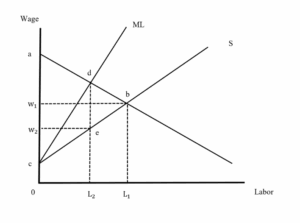
Figure 1 depicts the buyer-side economics of any firm with buyer-side market power. In this firm-level diagram, the downward sloping line is the demand curve, ML stands for marginal cost of labor, and S stands for supply.88Blair & Wang, supra note 85, at 33–34. In a competitive market, point b is the competitive amount of labor and the wage paid.89Id. To maximize profit, a monopsonist will reduce employment from L1 to L2 and reduce the wage paid from W1 to W2, at point e.90Id. at 34. Employer surplus would rise, and employee surplus would fall, as employee surplus equal to (W1 – W2)L2 is converted into employer surplus.91Id. The triangle d-e-b represents overall welfare loss.92Id. As Professors Roger Blair and Wenche Wang explain, “The main economic objection to buyer cartels is the loss in social welfare. But the importance of the wealth redistribution from labor to the firms should not be ignored.”93Id.
Bringing the economics back to the NCAA, the difference between W1 and W2 above represents the loss in wages to student-athletes.94See Blair & Wang, supra note 85, at 33–43. One can argue that W2 equals the value of an education and other benefits derived from NCAA plus any name, image, and likeness (“NIL”) payment.95See id. Recognizing that NCAA and its top conferences make incredible profit, however, as shown in Figure 2, student-athlete wage suppression only becomes more worrying.96Caron & McCann, supra note 12.
Figure 2: Every FBS School’s Football Expenses and Revenues
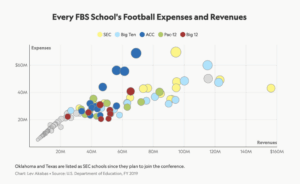
If the NCAA is viewed as a monopsonist, the NCAA has virtually all of the market power for collegiate athletics.97Berkman, supra note 7. Alternatively, considering schools and their conferences as a cartel, we can look at the market power demonstrated by the “Power Five” conferences.98See id. The “Power Five” included the Pac-12, which is no longer considered a power conference . Kelsey Dallas, Will the Pac-12 Become a “Power” Conference Again? Here’s What Fans Think, YahooSports (Sept. 12, 2024), https://perma.cc/95ZP-HHR9. Thus the “Power Four” remain. Id. The NCAA’s “Power Four” football conferences are: the Southeastern Conference (“SEC”), the Big Ten Conference, the Atlantic Coast Conference (“ACC”), and the Big 12 Conference. Bryan Kress, College Football Conference Realignments Explained: History, What to Know, Ticketmaster (Oct. 1, 2024), https://perma.cc/G575-55J3. The Power Five Conferences were the SEC, Big Ten, ACC, Pac-12, and Big 12, and they have had incredible market power as demonstrated by the revenues shown above.99Austin Curtright, What Happened to the Pac-12? Explaining the Fall and Rebuild for Former Power Five League, USA Today (Jan. 21, 2025, 11:28 AM), https://perma.cc/8BQP-GSEM. The Pac-12 has since disbanded, evidence of further consolidation.100See id.
In 2019, for instance, Texas A&M brought in the most football revenue of any Football Bowl Series (“FBS”) school with over $120 million in profit.101Caron & McCann, supra note 12. And with few exceptions, like Notre Dame, which does not play in any conference, the Power Five conferences brought in more revenue than any other conference. Thus, whether we examine the NCAA as a monopsonist or its most powerful conferences as a cartel, market power exists to reduce wages and amount of labor.
It is clear wages were suppressed by the NCAA and its members in the leadup to Alston. Previously, athletes were limited to receiving compensation beyond scholarships and some education-related costs.102John Wright, A New Era: Understanding the Historic NCAA v. House Settlement, Ave Maria Sch. of L.: Blog, Bus. L. Inst. (Jan. 28, 2025), https://perma.cc/5RML-X8RS. NIL has changed that.103Id. And one of the cases in the wake of Alston, the recently approved settlement in House v. NCAA104545 F. Supp. 3d 804 (N.D. Cal. 2021). is changing that and allowing some compensation for athletes.105Wright, supra note 102 (“This historic settlement changes the landscape of college sports in three major ways. First, players will be eligible to receive benefits from member schools that were previously prohibited by the NCAA. Second, former players will be compensated for the prior deprivation of their name, image, and likeness (NIL) rights. Third, the agreement establishes a groundbreaking revenue-sharing framework between member schools and athletes.” (footnotes omitted)).
Moreover, part of monopsony power is also a reduction in the amount of labor. With so few competitive spots at top schools, an inference can be made that concentrated power restricts recruiting to only the top athletes, and other good athletes are passed over by top programs, going instead to less competitive programs.
Since 2021, the NCAA has allowed players to make money off of NIL.106Sara Coello, What Is NIL in College Sports? How Do Athlete Deals Work?, ESPN (Sept. 26, 2024, 2:16 PM), https://perma.cc/2W3A-UCUG. While this does not necessarily represent the full pay the student-athlete would earn at a competitive level, it better approximates this value than scholarship money alone. Table 1 below represents NIL value (which can be correlated to social media presence) for the top five active student-athletes as of February 15, 2025.107On3 NIL Valuations, NIL 100, On3 Media, https://perma.cc/WUD2-S4TR. This website updates NIL values every Wednesday. Table 1 is meant as a sample to demonstrate the financial impact of NIL. As far as wages, there is clearly an abundance of money in the industry.
Table 1: Current NIL Value of Top Five Student-Athletes

II. The NCAA, Labor, and Antitrust: Before, During, and After Alston
A. Before Alston—The Founding of the NCAA and Cases Depicting the NCAA’s Relationship to Antitrust
While Alston most recently paved the way for increased student-athlete compensation, the debate about compensation began decades earlier.108See, e.g., NCAA v. Bd. of Regents of the Univ. of Okla., 468 U.S. 85, 88–93 (1984).
The NCAA was conceived by President Theodore Roosevelt and others with two purposes in mind: (1) setting standards for the health and safety of players and (2) ensuring that no student representing a university in collegiate sports be paid.109Brandon Posivak, The Demise of the Hub-and-Spoke Cartel and the Rise of the Student Athlete: A Significant Step Toward a New Era of Conferences in NCAA v. Alston, 31 U. Miami Bus. L. Rev. 38, 46 (2022). Since the beginning, the NCAA has been unable to keep all money outside of college sports.110Id. at 46–47 (noting that the NCAA “did little to prevent the commercialism of collegiate football and the intervention of affluent alumni in paying athletes to play their respective sport. Colleges and universities also began competing to provide the highest pecuniary incentives to entice players to attend their institutions and wear their colors.” (footnotes omitted)).
In 1948, the NCAA adopted the “Sanity Code,” in which the NCAA committed to opposing “promised pay in any form” to student-athletes and authorizing grant-in-aid scholarships.111NCAA v. Alston, 141 S. Ct. 2141, 2149 (2021) (internal quotation marks omitted) (Hearings Before the Subcomm. on Oversight and Investigation of the H. Comm. on Interstate and Foreign Com., 95th Cong. 1094 (1978)). In the following decades, the codes expanded the limitation on payments to “room, board, books, fees, and ‘cash for incidental expenses such as laundry’; permit[ed] paid professionals in one sport to compete on an amateur basis in another sport; and most recently, allow[ed] ‘athletic conferences to authorize their member schools to increase scholarships up to the full cost of attendance.’”112Posivak, supra note 109, at 47 (footnotes omitted) (quoting Alston, 141 S. Ct. at 2149–50).
By 1984, when NCAA v. Board of Regents of the University of Oklahoma113468 U.S. 85 (1984). was decided, the NCAA’s commercialization was obvious.114Posivak, supra note 109, at 49. This case, along with O’Bannon v. NCAA, 802 F.3d 1049 (9th Cir. 2015), has repeatedly been called one of the most important sport-related cases where students secured a victory. Id. at 49 n.51 (citing Seven Cases that Shaped Sports Since 1977, Athletic Bus. (Apr. 13, 2017), https://perma.cc/Q2ZZ-UJRE). Large schools like the University of Oklahoma and the University of Georgia wanted to televise more games nationally than the NCAA would allow.115Bd. of Regents of the Univ. of Okla., 468 U.S. at 94–95. In the 1980s, the NCAA limited the number of nationally and regionally televised football games to four national appearances and six total appearances in two years.116Posivak, supra note 109, at 49. While the universities argued that the NCAA’s conduct violated Section 1 of the Sherman Act, the NCAA argued that televising games reduced in-person attendance.117Id. Ultimately, the Supreme Court agreed with the universities and found that the NCAA’s restrictions violated the Sherman Act, stating that “consistent with the Sherman Act, the role of the NCAA must be to preserve a tradition that might otherwise die; rules that restrict output are hardly consistent with this role.”118Id. at 49–50 (quoting Bd. of Regents of the Univ. of Okla., 468 U.S. at 120) (embracing the rule of reason standard as opposed to per se illegality). The NCAA suffered another defeat in the United States Court of Appeals for the Tenth Circuit in 1998’s Law v. NCAA, 134 F.3d 1010, 1020–25 (10th Cir. 1998) (holding price fixing for coach salaries was anticompetitive and that the NCAA’s justification that price fixing would allow coaches to break into Division I coaching was not a valid justification). This Comment does not discuss this case further because it centers on coaches, not student-athletes.
Student-athlete compensation first became a significant issue in 2006 in White v. NCAA.119No. CV 06-999, 2006 WL 8066802, at *1 (C.D. Cal. Sept. 21, 2006) (describing a subset of different issues and grievances related to a discrepancy in grant-in-aid tuition money for student-athletes, the first major antitrust push for student-athletes in the twenty-first century). See Posivak, supra note 109, at 53. In White, a group of student-athletes challenged the NCAA’s limitation on its “full grant-in-aid athletic scholarships” that included tuition, mandatory fees, room, board, and required books but did not include optional fees, school supplies, and other expenses.120Posivak, supra note 109, at 53 (“For many student athletes, the pecuniary difference between the full cost of attendance and full grant-in-aid scholarship money provided by the school ranged from $1,500-$6,000 depending on the school’s geographic location.”). The student-athletes in White alleged that the NCAA and its member institutions agreed to limit student-athlete compensation that “‘unreasonably restrained trade through the imposition of a cap on athletic-based financial aid in violation of § 1 of the Sherman Act’ because the cap prevented them from covering the complete cost of their attendance.”121Id. at 53–54 (quoting Thomas A. Baker III, Joel G. Maxcy & Cyntrice Thomas, White v. NCAA: A Chink in the Antitrust Armor, 21 J. Legal Aspects Sport 75, 76 (2011)). The parties ultimately settled before trial, with the NCAA allowing schools to purchase health insurance for student-athletes and establishing 10 million fund to compensate past student-athletes.122See id. at 54; see also Important NCAA Lawsuits, Athnet, https://perma.cc/F2B5-USWP (laying out the terms of the NCAA’s ultimate settlement with the group of student-athlete plaintiffs in White and noting that in addition to the schools now being able to purchase health insurance for its student-athletes, they also provided two separate funds that were combined together into one to further benefit student-athletes for purposes other than health insurance, including student-athletes receiving additional money in their academic pursuits); Thaddeus Kennedy, NCAA and an Antitrust Exemption: The Death of College Athletes’ Rights, Harv. J. Sports & Ent. L. (Aug. 31, 2020), https://perma.cc/AXZ6-DKLM.
The first significant case involving student-athletes’ NIL, a form of payment not directly provided by schools, was O’Bannon v. NCAA.123802 F.3d 1049 (9th Cir. 2015); id. at 1052; Posivak, supra note 109, at 54. A group of student-athletes led by Edward O’Bannon—a basketball player, former All-American, and 1995 National Champion for the University of California, Los Angeles—sued the NCAA under Section 1 of the Sherman Act for using their NIL in video games without consent or compensation.124See O’Bannon, 802 F.3d at 1055; see also Posivak, supra note 109, at 54–55, 55 n.82. The NCAA contended (1) that its amateurism rules were “valid as a matter of law” under Board of Regents, (2) that the compensation rules were not covered by the Sherman Act, and (3) that the plaintiffs did not have antitrust standing.125O’Bannon, 802 F.3d at 1061 (internal quotation marks omitted) (quoting NCAA v. Bd. of Regents of Univ. of Okla., 468 U.S. 85 (1984)). The court found “none of these three arguments persuasive.”126Id. It largely agreed with the district court:
(1) that a cognizable “college education market” exists, wherein colleges compete for the services of athletic recruits by offering them scholarships and various amenities, such as coaching and facilities; (2) that if the NCAA’s compensation rules did not exist, member schools would compete to offer recruits compensation for their NILs; and (3) that the compensation rules therefore have a significant anticompetitive effect on the college education market, in that they fix an aspect of the “price” that recruits pay to attend college (or, alternatively, an aspect of the price that schools pay to secure recruits’ services).127Id. at 1070. The Court of Appeals for the Ninth Circuit found “that the district court clearly erred in analyzing the third Rule of Reason factor because ‘an alternative must be “virtually as effective” in serving the procompetitive purposes of the NCAA’s current rules, and “without significantly increased cost”‘ but that ‘allowing students to be paid compensation for their NILs is virtually as effective as the NCAA’s current amateur-status rule.’” Posivak, supra note 109, at 57–58 (quoting O’Bannon, 802 F.3d at 1074).
Nonetheless, O’Bannon was a key victory for student-athletes because “the Ninth Circuit recognized and defined the student athletes’ cognizable labor market, which the NCAA had vehemently opposed as a lynchpin of its argument for the necessity of its compensation restraints.”128Posivak, supra note 109, at 58.
Between O’Bannon and Alston, states like California began passing “Fair Pay to Play” Acts.129Id. at 58–60. The acts allow student-athletes to profit from their NIL and forbid NCAA rules that prevent student-athletes from earning compensation.130Id. at 58–59. But the NIL laws were not nationwide; labor was still unpaid aside from grant-in-aid. The stage was set for Alston.
B. Alston
A class of student-athletes filed a lawsuit in federal district court against the NCAA, alleging that the NCAA’s limits on student-athlete compensation violated Section 1 of the Sherman Act.131See NCAA v. Alston, 141 S. Ct. 2141, 2147 (2021). The district court opinion “cut both ways,” with partial victories for the athletes and the NCAA.132Id. The NCAA was not satisfied with the decision and appealed.133Id. The Supreme Court granted certiorari to address the NCAA’s argument it had “immunity from the normal operation of the antitrust laws” and its argument that “the district court should have approved all of its existing restraints.”134Id.
Justice Gorsuch authored the majority opinion in Alston.135Id. He began by noting that the Court “took this case to consider [the NCAA’s] objections” to the antitrust laws.136Id. In section I.A, he discussed the NCAA’s commercialism since its inception.137Alston, 141 S. Ct. at 2148–51; see supra, Section II.A. With clarity, he noted: “Over the decades, the NCAA has become a sprawling enterprise” and calls the NCAA “a massive business.”138Alston, 141 S. Ct. at 2150. To emphasize this point, the opinion called out the NCAA’s greed:
Those who run this enterprise profit in a different way than the student-athletes whose activities they oversee. The president of the NCAA earns nearly $4 million per year. Commissioners of the top conferences take home between $2 to $5 million. College athletic directors average more than $1 million annually. And annual salaries for top Division I college football coaches approach $11 million, with some of their assistants making more than $2.5 million.139Id. at 2151 (emphasis added) (citations omitted).
In section 1.B, the Court discussed the district court’s ruling, and in section 1.C, the Court discussed which issues both sides agreed on.140Id. at 2151–55. The Court noted that “some of the issues most frequently debated in antitrust litigation are uncontested.” Id. at 2154. “Put simply, this suit involves admitted horizontal price fixing in a market where defendants exercise monopoly control.” Id.
Getting to the key argument in section II, the Court stated: “The NCAA accepts that its members collectively enjoy monopsony power in the market for student-athlete services, such that its restraints can (and in fact do) harm competition. . . . [T]he NCAA’s status as a particular type of venture categorically exempt its restraints from ordinary rule of reason review.”141Id. at 2156. The Court further opined whether the NCAA’s restrictions “yield benefits in its consumer market that can be attained using substantially less restrictive means.”142Id. at 2157.
The opinion went on to dispose of the NCAA’s reliance on Board of Regents as allowing restriction of payment for student-athletes.143Id. at 2157–58. The NCAA argues that it plays a critical role in the maintenance of a revered tradition of amateurism in college sports. There can be no question but that it needs ample latitude to play that role, or that the preservation of the student-athlete in higher education adds richness and diversity to intercollegiate athletics and is entirely consistent with the goals of the Sherman Act. Id. at 2157 (internal quotation marks omitted) (quoting NCAA v. Bd. of Regents of the Univ. of Okla., 468 U.S. 85, 120 (1984)).
To the extent it means to propose a sort of judicially ordained immunity from the terms of the Sherman Act for its restraints of trade—that we should overlook its restrictions because they happen to fall at the intersection of higher education, sports, and money—we cannot agree. This Court has regularly refused materially identical requests from litigants seeking special dispensation from the Sherman Act on the ground that their restraints of trade serve uniquely important social objectives beyond enhancing competition.147Id. at 2159. The Court uses two examples from National Society of Professional Engineers v. United States, 435 U.S. 679 (1978), and FTC v. Superior Court Trial Lawyers Ass’n, 493 U.S. 411 (1990), to support its analysis and differentiating the NCAA from professional baseball. See id. at 2159–60.
Though the Court agreed that the proper antitrust test is not “the least restrictive means” but is the “degree[] of reasonable necessity,”148Id. at 2161 (internal quotation marks omitted) (quoting Rothery Storage & Van Co. v. Atlas Van Lines, Inc., 792 F.2d 210, 227 (D.C. Cir. 1986)). the Court noted that “we see nothing about the district court’s analysis that offends the legal principles the NCAA invokes.”149Id. at 2162. Ultimately, the majority affirmed the district court’s decision, noting that “[s]ome will think the district court did not go far enough.”150Id. at 2166. Nonetheless, the Court did not alter the district court’s finding that the NCAA’s rules limiting undergraduate athletic scholarships and compensation for athletic performance were proper, and it upheld the NCAA’s rules limiting the education-related benefits schools may offer student-athletes, like graduate or vocational scholarships.151See id.
Justice Kavanaugh would have gone further than the majority in supporting compensation for student-athletes and noted “that the NCAA’s remaining compensation rules also raise serious questions under the antitrust laws.”152See id. at 2166–67 (Kavanaugh, J., concurring) (“But this case involves only a narrow subset of the NCAA’s compensation rules—namely, the rules restricting the education-related benefits that student athletes may receive, such as post-eligibility scholarships at graduate or vocational schools. The rest of the NCAA’s compensation rules are not at issue here and therefore remain on the books. Those remaining compensation rules generally restrict student athletes from receiving compensation or benefits from their colleges for playing sports. And those rules have also historically restricted student athletes from receiving money from endorsement deals and the like.”). He emphasized three points: (1) that the Court did not address the remaining compensation rules; (2) that the rule of reason should govern NCAA rules; and (3) that the NCAA lacks the requisite procompetitive justification for the rules.153Id. at 2167. He concluded with clarity:
Nowhere else in America can businesses get away with agreeing not to pay their workers a fair market rate on the theory that their product is defined by not paying their workers a fair market rate. And under ordinary principles of antitrust law, it is not evident why college sports should be any different. The NCAA is not above the law.154Id. at 2169. Justice Kavanaugh also noted that “the student athletes who generate the revenues, many of whom are African American and from lower-income backgrounds, end up with little or nothing.” Id. at 2168.
C. Alston’s Immediate Impact
Alston’s impact was clear: The 2023 Merger Guideline used Alston as its primary support for antitrust-labor guidelines.155See 2023 Draft Merger Guidelines, supra note 75, at 25–26, 26 n.78. And the NCAA changed its NIL guidelines shortly after the Alston decision, giving the three NCAA divisions the ability to manage student-athlete compensation guidelines for NIL.156Dennis Dodd, NCAA Unveils Modernized Constitution Draft with Divisions Granted Increased Governing Power, CBS Sports (Nov. 8, 2021, 12:45 PM), https://perma.cc/NSE9-LPBT.
For student-athletes, the change in policy for NIL has meant a windfall.157Erica Hunzinger, One Year of NIL: How Much Have Athletes Made?, AP News (July 6, 2022, 4:57 PM), https://perma.cc/7N4V-SKWS. Overall, an estimated $917 million was spent by companies on paying student-athletes for their NIL in 2022, the first full year of data as noted in Figure 3 below.158Id. Figure 3 notes that the average NIL deal increased from $1,524 in the first year to $1,815 in the second year. Although the women’s overall average was just $1,084, the average deal for women’s gymnastics, featuring stars like Livvy Dunne, was over $7,000.159Livvy Dunne is mentioned at her 2025 NIL value in Table 1, supra Section I.C.
Figure 3: A Snapshot of NIL Spending

And in the lower courts, student-athletes continue to speak up for their rights. In Johnson v. NCAA,160No. 19-5230, 2021 WL 6125095 (E.D. Pa. Dec. 28, 2021), aff’d in part, vacated in part, remanded, 108 F.4th 163 (3d Cir. 2024). the plaintiff student-athletes claimed “‘that as college athletes they were employees of their respective institutions and that the NCAA was their joint employer,’ and in turn, the student athletes argued they were owed ‘a required minimum wage pursuant to the Fair Labor Standards Act (FLSA).’”161Posivak, supra note 109, at 85 (quoting Chris Lucca & David Singh, NCAA and Multiple Member Schools Seek Instant Replay Review by Third Circuit, Law.com (Oct. 27, 2021, 11:13 AM) https://perma.cc/3ZAC-F75V).
III. Antitrust Jurisprudence Does Not Require Formal Employment, an Advantage for Informal Employees Seeking Recourse
Antitrust-labor analysis is a better avenue for informal workers than the FLSA, however, because the FLSA requires formal employment. Indeed, in Johnson, the district court noted that “[i]n order to state cognizable claims for violation of the FLSA, . . . the Complaint must plausibly allege that Plaintiffs are employees of the colleges and universities they attend.”162Johnson, 2021 WL 6125095, at *3.
To state cognizable labor antitrust claims, in contrast, plaintiffs need only survive a rule of reason analysis, and need not specify employment status.163See NCAA v. Alston, 141 S. Ct. 2141, 2151 (2021). As the Alston majority noted, “Determining whether a restraint is undue for purposes of the Sherman Act ‘presumptively’ calls for what we have described as a ‘rule of reason analysis.’”164Id. (first quoting Texaco Inc. v. Dagher, 547 U.S. 1, 5 (2006); and then quoting Standard Oil Co. of N.J. v. United States, 221 U.S. 1, 60–62 (1911)). Unlike identifying employment status, “[t]hat manner of analysis generally requires a court to ‘conduct a fact-specific assessment of market power and market structure’ to assess a challenged restraint’s ‘actual effect on competition.’”165Id. (quoting Ohio v. Am. Express Co., 585 U.S. 529, 541 (2018)). Justice Kavanaugh similarly explained in his Alston concurrence that the compensation rules at issue “should receive ordinary ‘rule of reason’ scrutiny under the antitrust laws.”166Id. at 2167 (Kavanaugh, J., concurring).
So, when examining labor in areas where employment status is tenuous, antitrust analysis should be used as a framework for obtaining higher pay. A complaint need not allege employment, but rather only a “fact-specific assessment of market power and market structure’ to assess a challenged restraint’s ‘actual effect on competition.’”167See id. at 2151 (majority opinion) (quoting Am. Express, 585 U.S. at 541); Johnson, 2021 WL 6125095, at *3.
IV. Courts Should Accept This Monopsony Rule of Reason Framework in Other Industries
A. Applying the Rule of Reason Framework from Alston
1. What Does Monopsony Mean Post-Alston?
Because monopsony power exists in industries other than college or professional athletics, the rule of reason framework used in Alston can and should be applied in other industries where monopsony power exists. As Professor Alan Manning of the London School of Economics noted:
The key idea behind monopsony is that the labor supply curve to an individual employer is not infinitely elastic so that an employer that cuts wages by 1 cent may find it harder to recruit and retain workers but does not immediately lose all its existing workers to competitors as is predicted by the perfectly competitive model.168Alan Manning, Monopsony in Labor Markets: A Review, 74 Indus. & Lab. Rels. Rev. 3, 3–4 (2021).
While the consensus around monopsony used to be based on uniqueness and idiosyncrasies in job type, a modern view of monopsony is based on the idea that it takes time for workers to find and change jobs.169Id. at 9–10 (noting further that classical monopsony models tend to be static while modern monopsony models take into account the dynamic decision-making which workers regularly engage in when exploring employment opportunities). Embracing friction in the labor market, as opposed to focusing on the uniqueness of the type of labor, is key to understanding this framework. Where there is friction, there is the potential for monopsony power, “even in online markets that, a priori, one might have thought would be very competitive.”170Id. at 4. Even when employment status is unclear, like in the case of independent contractors, antitrust analysis can provide insight in a monopolistic market.
One example of a market where there may be some surprising amount of friction and monopsony power is the rideshare industry, where drivers are typically independent contractors.171Id. at 5. While the FLSA could be little help to rideshare drivers due to the difficulty in finding that drivers are employees rather than independent contractors,172See, e.g., Erica E. McCabe, Not Like the Others: Applying the Fair Labor Standards Act to the Sharing Economy, 65 U. Kan. L. Rev. 145, 146 (2016) (noting that classifying sharing economy workers as employees or independent contractors under statutes like the FLSA is one of the “largest problems facing American labor and employment law today”). antitrust jurisprudence has no such requirement.173See Richard Johnson, Explaining Johnson v. NCAA and What’s at Stake in Wednesday’s Court Hearing, Sports Illustrated (Feb. 15, 2023), https://perma.cc/T5JD-GPDS. Indeed, plaintiffs have already found some success in negotiating wages under antitrust jurisprudence.174Jonathan Stempel, Uber, Lyft to Pay $328 Million to Settle New York Wage Theft Claims, Reuters (Nov. 2, 2023, 12:11 PM), https://perma.cc/2KP2-CQZU.
Friction occurs even amongst rideshare platforms. Where Uber and Lyft both operate, friction between jobs is lower but still “very considerable potential monopsony power” can occur.175Manning, supra note 168, at 5. The study on Uber and Lyft friction found a response, but all elasticities were less than one, indicating inelasticity, which was a “perhaps surprising” result because rideshare drivers can freely shift between apps and can work for both simultaneously. Id. So, while monopsony power may be less when Uber and Lyft both share a market, it still exists.176Perhaps this is because the two companies together represent a driver duopsony. See Uber and Lyft: A Textbook Case of Duopoly?,Emory Econ. Rev., https://perma.cc/J9ND-CL59. Though arguing the market for rideshare drivers is a monopsony has not entirely been tested, when drivers filed a wage theft case after Alston against Uber and Lyft, the case settled, resulting in higher wages for drivers.177Stempel, supra note 174 (noting that Uber and Lyft paid a combined $328 million to settle New York wage theft claims (Uber paid $290 million, and Lyft paid $38 million)).
As this Uber and Lyft example illustrates, one possible solution to the challenges facing labor litigation is to require a measurement of wage elasticity as part of Alston’s rule of reason analysis. Unfortunately, this is not entirely feasible: “Very few papers seek to estimate directly the overall wage elasticity of labor supply to the firm, perhaps because it is hard to find suitably exogenous variation in wages in a single firm.”178Manning, supra note 168, at 4 (emphasis added) (footnote omitted). While demonstrating monopsony power through wage elasticity may bolster evidence for monopsony power, requiring elasticity is too difficult in general.
Instead, courts should take a looser approach to monopsony power and accept plaintiffs’ arguments demonstrating that there is a high degree of friction in their respective industries. This is in line with “modern monopsony” theory.179See id. at 5–8. Modern monopsony takes note of the ratio of employees flowing into a firm divided by the rate employees quit a firm. Id. at 5. Studies embracing this view of monopsony seem to find more monopsony in the labor market than the classical view of monopsony. Id. at 7. Other views of monopsony include the “new classical” view of monopsony, and the Herfindahl-Hirschman Index (“HHI”). HHI measures concentration in a market and can be applied to labor markets. Id. at 8. By providing evidence that there is some friction in switching jobs, plaintiffs seeking higher wages can show that monopsony power exists and that the court in question should apply the Alston framework. Consequently, in some industries, there would not need to be any inquiry whether plaintiffs are independent contractors or workers under the FSLA—they could seek relief through antitrust proceedings.
2. How Nurses Can Use the Rule of Reason to Successfully Argue Claims of Suppressed Wages
Other than Uber and Lyft drivers, one class of potentially underpaid workers is nurses.180See Kate Bahn, How Labor Friction and Social Fiction Relate to the Gender Wage Gap, Ctr. for Am. Progress (Apr. 27, 2016),https://perma.cc/LF5K-P99B. In particular, nurses in large hospital systems could argue that they are underpaid due to hospital systems’ monopsony power exerted on their labor.181See id. Nurses can work either as employees or independent contractors within the healthcare field.182See, e.g., Nursing as an Independent Contractor, NurseRegistry, https://perma.cc/AC3P-D2XY. In addition, nurses working in large hospital systems may find difficulty switching jobs to a different hospital system due to the sheer size of the hospital systems and other regulatory and licensing barriers.183See generally Anna Falvey, 100 of the Largest Hospitals and Health Systems in America | 2023, Becker’s Hosp. Rev. (Jan. 10, 2023), https://perma.cc/8PLJ-SUPC (listing the forty largest health systems ranked by number of hospitals, with data current as of January 2023). To illustrate, Table 2 below compares the size of the largest five hospital systems in the United States with the number of nurses those hospital systems employ.
Table 2: Nurse Quantity by Hospital System

Because it is the largest hospital system, this Comment uses HCA Healthcare as an example of hospital systems’ ability to exert monopsony power and keep wages lower than a competitive rate for nurses. Demonstrating the sheer size of this hospital system, forty-five of HCA Healthcare’s offices are in Florida alone.184HCA Healthcare Fact Sheet, HCA Healthcare (June 30, 2019), https://perma.cc/F8ZD-3FFS.
Nurses who work for HCA Healthcare went on strike in 2024 due to poor staffing, poor recruitment, and poor retention.185Press Release, Nat’l Nurses United, More than 100 Nurses to Rally at HCA Office in Tampa (Nov. 27, 2023), https://perma.cc/44N4-SDRW. Indicating that other healthcare systems face similar labor concerns, in response to the strike, a representative from HCA Healthcare noted that “[t]oday’s small protest by NNU (National Nurses United) is no different than their protests against countless health systems across the country.”186Jackie Llanos, ‘Plain Old Greed:’ HCA Nurses Rally to Denounce Understaffing, Unsafe Conditions at Hospitals, Fla. Phoenix (Nov. 30, 2023, 5:00 PM) (internal quotation marks omitted) (quoting Debra McKell, Director of Media Relations for HCA Healthcare’s West Florida Division), https://perma.cc/E5XE-GA2U. Furthermore, nurses in HCA Healthcare hospitals report that they do not or cannot take breaks during their shifts.187See id. The logical conclusion from the sheer size of HCA Healthcare and the fact that nursing is highly regulated and requires special skills is that large hospital systems demonstrate monopsony power.188See Bahn, supra note 180. This leads to lower wages, which are suppressed due to HCA Healthcare’s monopsony power over registered nurses.
The HCA Healthcare spokesperson recognized that these concerns came against the backdrop of contract negotiations,189See Llanos, supra note 190. which concluded in October 2024.190Lucy Diavolo, HCA Nurses Win New Contracts, Nat’l Nurses United (Dec. 20, 2024), https://perma.cc/H962-F3R2 (“Nurses say their newly ratified agreements include measures to improve patient care, patient safety, nurse retention, and working conditions at their hospitals.”). Underpaid nurses in a large hospital system such as HCA Healthcare could continue to argue for a better contract at their next negotiation. In a negotiation context, the nurses could use the rule of reason framework within antitrust as leverage in negotiation for higher wages and better retention. Or, in a litigation context, they could also file an antitrust suit and actually use the Alston framework. Below, this Comment argues that the nurses should be successful in such a challenge and illustrate how such arguments would proceed.
As required by the Sherman Act and antitrust caselaw, the plaintiffs would have to prove that the hospitals had an agreement that unreasonably restrained trade.191See Francis & Sprigman, supra note 26, at 7. Such an agreement would be between the individual hospitals that are part of the hospital system. In line with Alston’s rule of reason, the burden of production would fall on plaintiffs to identify anticompetitive practices.192See NCAA v. Alston, 141 S. Ct. 2141, 2162 (2021). Here, they would explain the hospital systems’ monopsony power, which would exist due to friction in changing nursing jobs from regulatory requirements and the size of the hospital systems.193See id. at 2151 (“In applying the rule of reason, the district court [correctly] began by observing that the NCAA enjoys ‘near complete dominance of, and exercise[s] monopsony power in, the relevant market . . . .’” (second alteration in original) (quoting In re NCAA Grant-in-Aid Cap Antitrust Litig., 375 F. Supp. 3d 1058, 1097 (N.D. Cal. 2019))). The plaintiffs would have an opportunity to present economic evidence explaining the effects of monopsony on suppressed wages.
Then, the burden of production would shift to the defendant to provide procompetitive justifications for their practices. Here, like in Alston, the nature of the industry would not be a valid excuse for exercising monopsony power.194See id. at 2157 (“[T]he NCAA ‘seeks to market a particular brand of football’ in which ‘athletes must not be paid, must be required to attend class, and the like.’” (quoting NCAA v. Bd. of Regents of the Univ. of Okla., 468 U.S. 85, 101–02 (1984))). “On the NCAA ‘s telling, these observations foreclose any rule of reason review in this suit. Once more, we cannot agree.” Id. at 2157–58. The hospital system could potentially counterargue that since nurses contend there is understaffing in the hospitals, that indicates nurses are free to move to other hospitals that pay better. However, their argument should not be successful. Exercising monopsony power means that quantity of labor is likely restricted in the market, below competitive levels.195See supra Figure 1. Quantity of labor lowers from L1 to L2 in monopsony. In practice, this means that fewer nurses are hired than the optimal competitive level across the market—in other words, nursing shortages.196Robert Rosseter, Fact Sheet: Nursing Shortage, Am. Ass’n of Colls. of Nursing (May 2024), https://perma.cc/4XQ8-NN3Z.
Hospital systems would also likely argue that patient care is not compromised due to nurses’ wages.197Llanos, supra note 190 (denouncing the claim that patient care is compromised due to nurse wages because they “are proud of the excellent care [they] provide to [their] patients”). Like in Alston, the test is not necessarily finding the least restrictive alternative to paying a fair wage; the test is the “degree[] of reasonable necessity” of the challenged practices.198NCAA v. Alston, 141 S. Ct. 2141, 2161 (2021) (internal quotation marks omitted) (quoting Rothery Storage & Van Co. v. Atlas Van Lines, Inc., 792 F.2d 210, 227 (D.C. Cir. 1986)). Lower wages have no reasonable necessity besides profits for a large hospital system, and nursing shortages decrease patient care.199Llanos, supra note 190 (arguing that nurses skip breaks due to low staffing, and that intensive care nurses are overwhelmed due to a reduced quantity in nurses). A court would therefore likely not find procompetitive justifications persuasive in this case.
Finally, in balancing the anticompetitive effects and procompetitive justifications, the court should find in favor of plaintiffs, assuming they provide sufficient evidence of wage suppression compared to a competitive market. Put simply, in a monopsonistic market for nurses, there is a restriction in wages and quantity of nurses that likely harms both nurse wages and patient care. Even weighing any procompetitive justification, lower nurses wages and worse patient care would tip the scales toward the conclusion that a hospital system with monopsony power violated antitrust laws.
B. If There Is No Friction, There Is Not Sufficient Monopsony Power
This framework would not hold up well in industries where workers typically quickly change from job to job.200See Manning, supra note 168, at 5–6. Put simply, monopsony power is weakened by the ability to change jobs easily.201See id. So, the Alston framework would not hold up in markets where there are numerous, interchangeable employers for an employee to move to when wages are below market value.
One example where Alston may not work would be in the market for entry-level fast-food workers. Entry-level fast-food work is relatively undifferentiated and requires little to no education or training, especially when compared to managerial positions even within the same company. Indeed, plaintiffs tried cases in the fast-food market against McDonald’s and Jimmy John’s shortly after Alston, endeavoring unsuccessfully to use Alston’s rule of reason framework for underpayment issues in monopsony.202A. Christopher Young, Jan Levine & Robyn English-Mezzino, Class Certification Denied in Two Fast-Food Franchise No-Poach Antitrust Lawsuits, Am. Bar Ass’n (Sept. 15, 2021), https://perma.cc/TY2U-G84U (noting that more abbreviated, “quick-look” version of rule of reason analysis “applies only in rare situations, where the court has ‘considerable experience with the type of restraint at issue,’” and that vertical restraints like franchise agreements always require full rule of reason analysis (quoting DeSlandes v. McDonald’s USA, LLC, No. 17 C 4857, 2021 WL 3187668, at *11 (N.D. Ill. July 28, 2021))). Both cases attempted to certify nationwide classes of fast-food workers.203Id. In both cases, however, each court found that “competition from other quick-service restaurant employers and others would ‘push the worker’s wages . . . up to the competitive level associated with the worker’s skills.’”204See id. (omission in original) (quoting Conrad v. Jimmy John’s Franchise, LLC, No. 18-CV-00133, 2021 WL 3268339, at *11 (S.D. Ill. July 30, 2021)) (“While other courts could disagree, these decisions represent big wins for employers and franchisors after the Alston decision, representing persuasive authority for limiting the use of quick-look analysis in franchise no-poach antitrust claims. Further, to the extent the rule of reason applies, the decisions illustrate the difficulty class plaintiffs and their counsel will face in trying to establish the predominance of common questions under the rule of reason when alleging both horizontal and vertical restraints.” (footnote omitted)).
However, even in the fast-food worker example, a smaller geographic cross-section of fast-food workers could be specific enough to demonstrate friction and monopsony power. To demonstrate, all Jimmy John’s workers in the United States may be too broad a class to show monopsony power in franchise agreements. A rule of reason analysis should not support a market for workers where the workers can seamlessly move between jobs within the market. But a class of Jimmy John’s managers, or a class of Jimmy John’s workers in a defined, remote area on an interstate may be more likely to show friction in ability to change jobs. If there are fewer options for jobs within the relevant market in these defined areas, then the increased friction should show evidence of monopsony power that plaintiffs can use in a rule of reason analysis.
Thus, the Alston framework likely cannot be used as an argument to raise wages in extremely large markets where workers and their job opportunities are plentiful, because sufficient monopsony power does not exist in such cases.
Conclusion
The NCAA’s experience in Alston is a clear indicator that the Supreme Court is taking notice of monopsony within antitrust laws. Labor and antitrust are as old as capitalism itself. In contrast with the FSLA, the Sherman Act does not require proof of formal employment status. Courts can and should recognize the rule of reason for other monopsonies in the realm of antitrust-labor, particularly in industries that have less formal employment structures where employment versus independent contractor status is a concern.